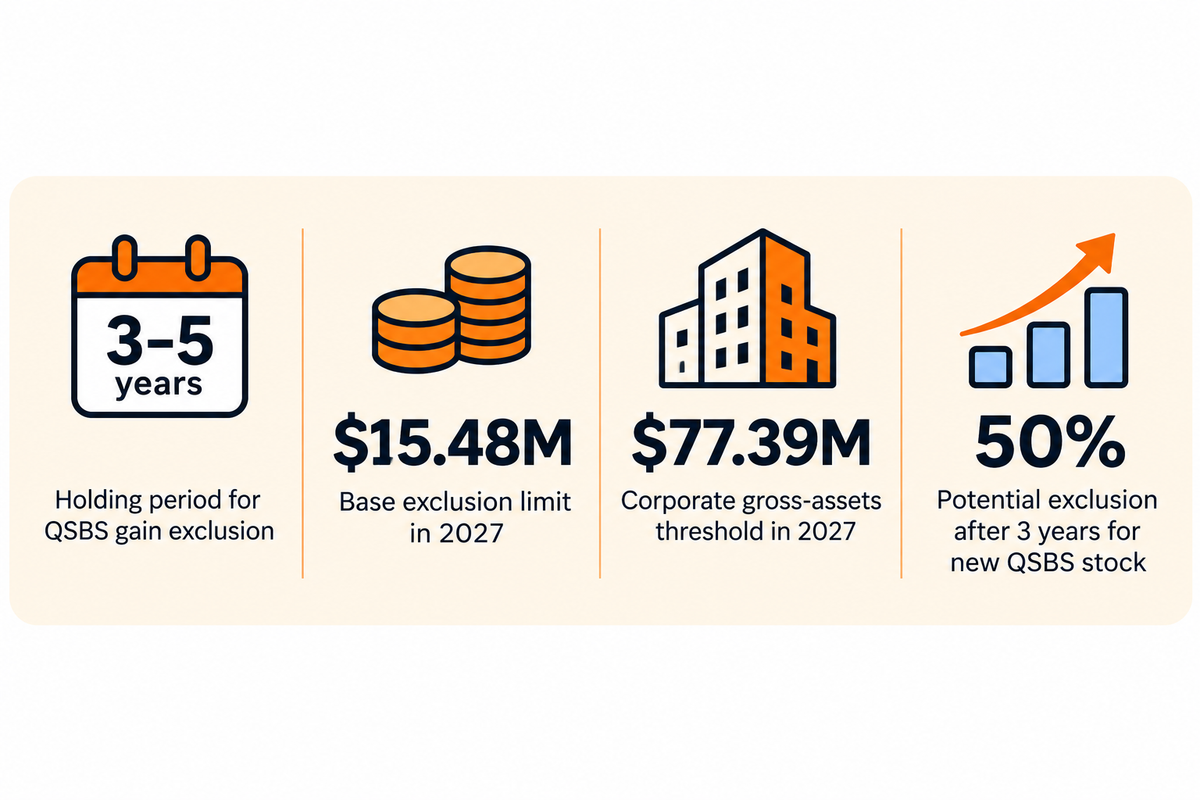
The 2025 tax law expanded the Qualified Small Business Stock (QSBS) exclusion, potentially allowing entrepreneurs to exclude millions of dollars in gains when they sell their companies.
But the new benefits don't automatically apply to stock acquired before the law changed.
If you received shares in 2024 and additional shares in 2026, those shares may be subject to different holding periods, exclusion percentages, and dollar limits. Understanding the difference before an exit could save you a substantial amount in federal taxes.
01What changed under the 2025 QSBS rules?
Before the law changed, qualifying stock acquired after September 27, 2010 generally had to be held for more than five years to receive a 100% federal capital gains exclusion.
For qualifying stock acquired after July 4, 2025, the exclusion is available sooner:
After 3 years → 50% of eligible gain excluded
After 4 years → 75% of eligible gain excluded
After 5 years → 100% of eligible gain excluded
The law also increased the base per-issuer exclusion limit from $10 million to $15 million and raised the corporate gross-assets threshold from $50 million to $75 million for stock issued after July 4, 2025.
These changes can be particularly valuable for entrepreneurs whose companies are acquired before the traditional five-year holding period is complete.
02What if you acquired shares in 2024 and 2026?
Consider an entrepreneur who acquired founder shares in April 2024 and additional qualifying stock in September 2026.
The company is sold in June 2030, generating $6 million in total capital gains.
The shares are from the same company, but the federal tax treatment is different.
2024 shares → $4 million gain → 100% excluded
2026 shares → $2 million gain → 50% excluded
The entrepreneur potentially excludes $5 million of the $6 million gain from federal income tax.
But what happens to the remaining $1 million?
The non-excluded portion of eligible QSBS gain is generally subject to a maximum 28% federal capital gains tax rate, rather than the usual 20% maximum rate. The additional 3.8% net investment income tax may also apply.
That means the remaining $1 million could generate up to $318,000 in federal taxes, before considering state taxes.
Had the 2026 shares been held for five years and satisfied the other QSBS requirements, that gain could potentially have been excluded entirely.
This simplified example assumes both stock blocks qualify, sufficient exclusion limits are available, and there are no other adjustments affecting the result.
The difference illustrates why the timing of an acquisition can have a meaningful impact on an entrepreneur's after-tax proceeds.
03Does the new $15 million exclusion apply to all your shares?
Not necessarily.
The older $10 million base exclusion limit generally continues to apply to qualifying stock acquired before the law changed. Newer qualifying stock may benefit from the $15 million base limit.
However, these amounts are not automatically additive. An entrepreneur cannot simply assume that selling older and newer shares of the same company produces a combined $25 million exclusion.
Earlier QSBS sales and dispositions of older shares in the same year can reduce the amount available for newer shares. The alternative limit based on 10 times qualifying stock basis may also affect the result.
For someone holding multiple blocks of stock, the actual exclusion depends on their acquisition history, prior transactions, and applicable limits.
This is one reason QSBS planning should happen before an exit, not after the transaction closes.
04What are the QSBS limits for 2027?
The IRS has announced the first inflation adjustments under the expanded QSBS rules.
For tax years beginning in 2027, the new-regime base exclusion limit increases to $15.48 million, while the corporate gross-assets threshold increases to $77.39 million.
The adjustments do not automatically increase the exclusion available for older stock or restore an exclusion limit that has already been exhausted.
Importantly, the corporate gross-assets test considers qualifying historical assets and assets immediately after issuance, not simply the company's valuation when shares are sold.
Source: IRS Revenue Procedure 2026-35.
05Why your stock acquisition date deserves a closer look
An entrepreneur may receive stock through several transactions over the life of a business. Founder shares, option exercises, SAFE conversions, restricted stock, and reorganizations can all introduce different tax considerations.
For example, receiving a stock option in 2024 and exercising it in 2026 generally does not mean the QSBS holding period began in 2024. Similarly, investing through a SAFE does not necessarily start the QSBS clock.
Special rules can also affect acquisition dates in certain transactions, so the documentation and transaction structure matter.
See our related article: Does a SAFE Start the QSBS Clock? Not Necessarily.
And remember, holding the shares long enough is only one part of QSBS eligibility. The company must also satisfy requirements involving its corporate structure, gross assets, business activities, and stock issuance history.
06Planning an acquisition or financing round? Review your QSBS position first.
QSBS eligibility can be affected by decisions made years before a company is sold. Financing rounds, equity changes, and restructurings can all influence the eventual tax treatment.
Talara helps entrepreneurs evaluate QSBS eligibility, review stock acquisition histories, and understand the tax implications of financing and acquisition decisions.
You can start with our free QSBS Eligibility Checker to identify potential issues.
If you hold shares acquired at different times or are approaching an exit, contact Talara for a personalized review. A relatively small difference in transaction timing or stock treatment can have a substantial impact on your after-tax proceeds.
This article is general information, not tax or legal advice. The rules are fact-specific, change over time, and depend on details unique to your company. Talk to us about how they apply to your situation.
© 2026 Talara Inc. All rights reserved.