You formed a Delaware C corporation because it seemed like the standard choice for a startup. Now your plans have changed. Maybe you're building a consulting business, working independently, or no longer planning to raise venture capital.
Would an LLC make more sense?
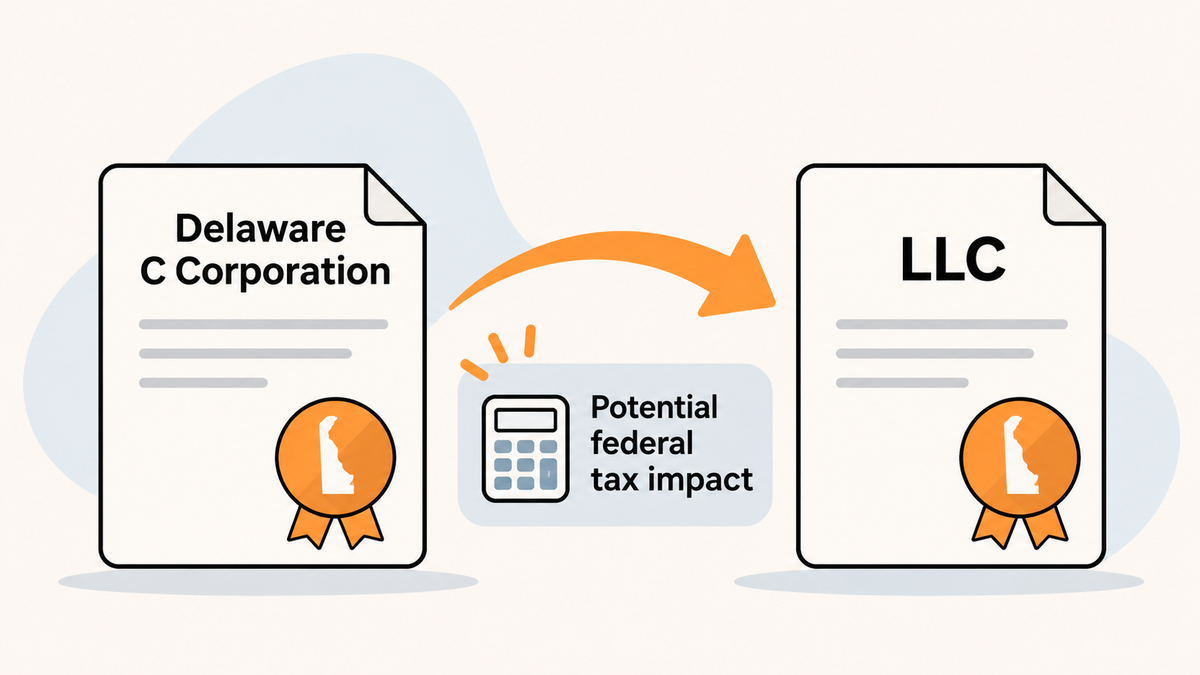
Yes, you can convert a Delaware C corporation into an LLC. Delaware law permits the conversion, but if the LLC will be taxed as a partnership or disregarded entity, the IRS generally treats the transaction as a corporate liquidation. That can trigger taxes even when no money changes hands.
The important question isn't whether you can convert. It's whether converting makes financial sense.
01Can a Delaware C Corporation Legally Convert to an LLC?
Yes. Under Section 266 of the Delaware General Corporation Law and Section 18-214 of the Delaware LLC Act, a Delaware corporation can convert into a Delaware LLC.
The process generally requires corporate approvals, a certificate of conversion, and an LLC certificate of formation.
Under Delaware law, the converted LLC generally continues the legal existence of the original corporation. Its property and obligations remain with the converted entity.
But Delaware's treatment of the conversion as a continuation does not determine its federal income tax consequences.
That distinction is critical.
02Is Converting a C Corp to an LLC Taxable?
Generally, yes, if the conversion changes the business from C corporation taxation to partnership or disregarded-entity taxation.
For federal tax purposes, the IRS generally treats the corporation as distributing its assets to its shareholders in liquidation.
If the new LLC has multiple owners and is taxed as a partnership, the shareholders are then treated as contributing those assets to the partnership.
This can create two levels of tax:
- Corporate level: The corporation may recognize gain on appreciated assets as though they were sold at fair market value.
- Shareholder level: Shareholders may recognize gain based on the value received in exchange for their stock, taking their tax basis into account.
The IRS explains the deemed liquidation rules.
Importantly, the company might owe tax without actually selling its assets or receiving cash.
Example: A Startup With Appreciated Software
Suppose a Delaware C corporation developed a software product.
The company's software has:
- Fair market value: $600,000
- Adjusted tax basis: $100,000
- Unrealized gain: $500,000
If the corporation converts into an LLC taxed as a partnership or disregarded entity, it may recognize the $500,000 gain even though the software remains in the business.
At the 21% federal corporate income tax rate, that could mean $105,000 in corporate tax, before considering available tax losses, deductions, and other adjustments.
There may also be shareholder-level taxes.
The actual cost depends on the valuation, asset basis, outstanding liabilities, available tax attributes, and shareholder circumstances.
Is a Tax-Free C Corp to LLC Conversion Possible?
Yes, in certain circumstances.
For example, when a qualifying domestic corporate parent owns at least 80% of a subsidiary's voting power and stock value, a complete liquidation may qualify for tax-free treatment under Sections 332 and 337.
However, additional requirements apply. Distributions to minority shareholders can still be taxable, and special rules may apply when the parent corporation is foreign or the subsidiary is insolvent.
These exceptions typically matter in corporate-group restructurings rather than conversions by individually owned startups.
03What If Your C Corp Has No Revenue or Assets?
This is where conversion may be more favorable.
Suppose you incorporated a Delaware C corporation six months ago. You never launched the business, raised outside funding, developed valuable intellectual property, or generated revenue.
If the corporation has little or no appreciated property, its corporate-level gain on conversion may be minimal.
However, no revenue does not necessarily mean no taxable gain.
A company can have valuable assets without generating sales. These may include software, intellectual property, goodwill, customer relationships, and going-concern value.
Accumulated tax losses also matter.
A corporation's net operating loss (NOL) carryforwards may offset some of the gain recognized in a taxable liquidation, subject to applicable limitations. However, unused NOLs generally do not transfer to individual owners or members of the new LLC. Special rules apply to qualifying corporate-group liquidations.
For early-stage companies, evaluating conversion before substantial value develops can make a significant difference.
04What Happens to QSBS If You Convert?
Qualified Small Business Stock (QSBS) under Section 1202 can allow eligible shareholders to exclude substantial capital gains when qualifying C corporation stock is sold or exchanged.
Converting to an LLC taxed as a partnership or disregarded entity generally eliminates the opportunity for future appreciation in the LLC interests to qualify as QSBS.
And the rules became more favorable in 2025.
Under the July 4, 2025 tax legislation, qualifying stock acquired after that date can receive a tiered gain exclusion:
- 50% after at least three years
- 75% after at least four years
- 100% after at least five years
The per-issuer exclusion limit also increased to the greater of $15 million or 10 times the shareholder's qualifying basis, with applicable limitations. The gross-asset threshold increased from $50 million to $75 million for stock issued after July 4, 2025.
For an entrepreneur who incorporated six months ago, the three-year minimum holding period has not been satisfied. A liquidation now would not qualify for the new QSBS gain exclusion.
There is an important nuance for older corporations: if stock already satisfies the applicable QSBS requirements, shareholder-level gain recognized in a liquidation may be eligible for exclusion. That does not eliminate any tax the corporation itself owes on appreciated assets.
If you expect to sell your business, giving up future QSBS benefits could be substantially more expensive than keeping your C corporation.
You can explore the requirements using Talara's QSBS Eligibility Checker.
05What If You Have Investors, SAFEs, or Stock Options?
A conversion becomes more complicated once other parties have rights in the corporation.
Outside investors may hold preferred stock or contractual protections that restrict a change in entity structure. Outstanding SAFEs, convertible notes, and employee stock options may also require special treatment.
Corporation stock and LLC membership interests are not interchangeable for every legal or tax purpose.
An LLC taxed as a partnership may also be less attractive to certain venture capital investors because of partnership tax reporting and investor-specific tax restrictions.
For a venture-backed company, retaining the C corporation structure is often the more practical choice.
06Does Converting Make Sense for Foreign Founders?
Foreign entrepreneurs should be particularly careful about converting an existing U.S. C corporation into an LLC.
A C corporation is a separate U.S. taxpayer. An LLC taxed as a partnership or disregarded entity can instead cause its foreign owners to have U.S. tax filing obligations directly, depending on the company's activities and income.
For example, a partnership with foreign members may have withholding obligations on income effectively connected with a U.S. trade or business.
A foreign-owned single-member disregarded LLC may still need to file Form 5472 with a pro forma Form 1120 when it has reportable related-party transactions.
The liquidation itself can also create cross-border tax or withholding considerations, depending on the shareholder and the assets involved.
These rules mean conversion does not necessarily simplify U.S. tax compliance.
The appropriate structure depends on where the owners live, where business activities occur, how income is sourced, and whether the company expects U.S. investment or an eventual sale.
07Will Converting to an LLC Save Delaware Franchise Taxes?
Not necessarily.
Delaware C corporations generally must file an annual report and pay franchise tax, calculated using one of two methods.
Delaware LLCs do not file the same annual report, but the annual LLC tax is $400 for 2026, due June 1, 2027. This is an increase from the previous $300 annual tax.
A corporation converting during the year must also address its outstanding corporate franchise tax and reporting obligations.
Delaware does not prorate its annual LLC tax. Under the state's rules, the annual tax is assessed if the LLC is active at any point during the applicable calendar year.
See the Delaware Division of Corporations' annual tax guidance.
Saving on annual state fees alone is rarely a sufficient reason to undertake a conversion that could create federal income tax liability.
08Are There Alternatives to Converting Your C Corp?
Possibly. The best solution depends on what you're trying to accomplish.
If your goal is pass-through taxation, an S corporation election may be worth examining if the corporation and its shareholders qualify.
Unlike a conversion to a partnership or disregarded entity, an S election generally does not trigger an immediate corporate liquidation.
However, if the company has appreciated assets when the S election becomes effective, certain built-in gains recognized during the following five-year recognition period may be subject to corporate-level tax under Section 1374.
S corporations also have ownership restrictions. Nonresident alien individuals cannot be S corporation shareholders, and S corporation stock does not qualify as QSBS.
If your C corporation is newly formed and has little activity, converting to an LLC may still be reasonable after evaluating the potential tax consequences.
And if you plan to raise institutional capital, issue equity compensation, or pursue a startup exit, keeping your C corporation may be the better long-term decision.
09Frequently Asked Questions
Can You Simply File Form 8832 to Change Your C Corp Into an LLC?
No. Form 8832 is used by eligible entities to elect their federal tax classification. It does not turn a corporation formed under Delaware corporate law into a Delaware LLC.
An LLC that previously elected C corporation taxation can generally elect partnership or disregarded-entity treatment if eligible, but that change is also generally treated as a taxable liquidation.
The fact that the business was legally an LLC all along does not make the tax classification change tax-free.
Can You Avoid Conversion Taxes by Dissolving the Corporation and Forming a New LLC?
Generally, no. Dissolving the corporation and transferring its business assets into a new LLC can trigger similar liquidation tax consequences.
Changing the legal steps does not automatically eliminate the underlying federal tax.
10Before Converting, Understand the Full Tax Cost
A Delaware C corporation can become an LLC, and for some early-stage businesses, that may be the right decision.
But the consequences depend on more than when the company was incorporated or whether it has generated revenue.
The value of its assets, accumulated tax losses, ownership structure, existing equity arrangements, and future business plans can all change the outcome.
Talara helps startups and growing businesses evaluate entity structures, estimate conversion tax consequences, and plan for future growth.
If you've already incorporated and are reconsidering your decision, we can help determine whether converting now makes sense or whether another approach would better protect your business.
Discuss your business structure with Talara.
This article is general information, not tax or legal advice. The rules are fact-specific, change over time, and depend on details unique to your company. Talk to us about how they apply to your situation.
© 2026 Talara Inc. All rights reserved.